
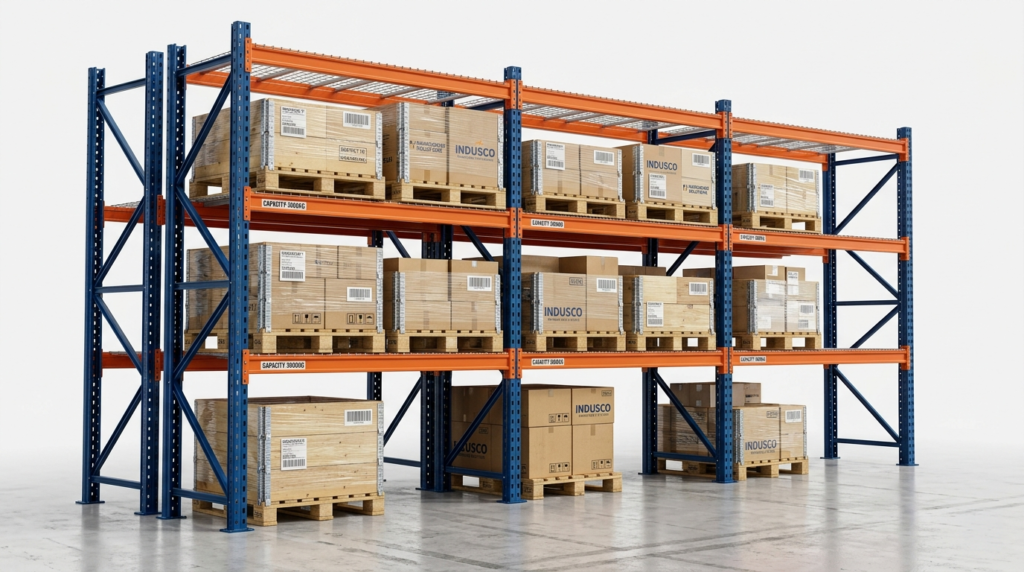
When buying industrial storage racks, B2B procurement managers must consider three primary factors: load capacity requirements, warehouse space utilization, and forklift compatibility. Selecting the wrong racking infrastructure leads to severe warehouse safety hazards, premature equipment failure, and restricted warehouse material flow. To maximize ROI and structural integrity, facility operators must evaluate structural steel grades, safety compliance certifications, and customized spatial layouts tailored to their specific palletized inventory.
Quick Checklist: Key Takeaways for Industrial Racking Procurement
Structural Material Grade: Insist on certified Q235B steel or higher for industrial applications.
- Load Capacity Per Level: Always calculate the maximum pallet weight plus a 15% safety buffer.
- Forklift Turning Radius: Ensure your aisle widths match your material handling equipment’s minimum turning specification.
- Engineering Layout: Utilize professional CAD warehouse layout services to avoid spatial errors prior to manufacturing.
1. Main Types of Industrial Storage Racks & Their Applications
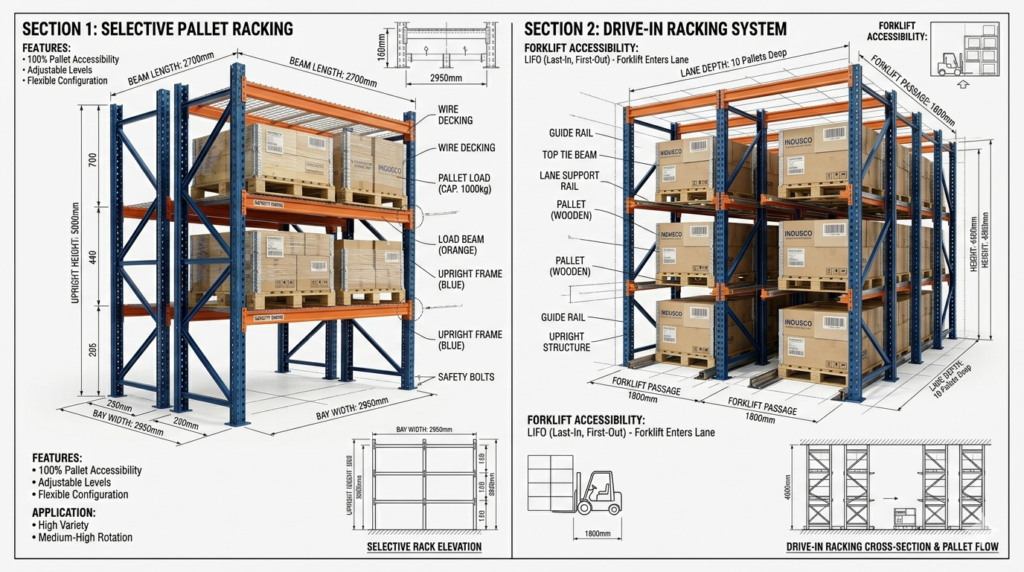
Industrial storage racks are not one-size-fits-all solutions. The architecture of your warehouse racking system directly dictates your operational workflow, inventory rotation speed, and overall storage density. Understanding the engineering differences between common industrial shelving types allows you to select the optimal setup for your facility.
Selective Pallet Racks (The Most Common Solution)
Selective pallet racking is the standard engineering configuration across the global logistics industry, widely recognized for its efficiency in standard pallet rack infrastructure. It offers 100% selectivity, meaning a forklift operator can access any individual pallet at any given moment without moving adjacent stock. This setup relies on a framework of vertical upright frames and horizontal load beams. It is the ideal layout for distribution centers with high SKU diversity and fast stock rotation (First-In, First-Out or FIFO inventory management). However, selective racking requires numerous access aisles, which limits total spatial density compared to specialized high-density setups. If you are looking to balance maximum accessibility with cost efficiency, explore our heavy-duty industrial storage racks solutions.
Drive-In / Drive-Through Racks (For High-Density Storage)
For facilities handling high-volume, low-SKU inventory, drive-in racking systems offer an engineered leap in storage density. By eliminating standard access aisles, forklifts drive directly into the racking bays to deposit or retrieve pallets stored on continuous structural rails. Drive-in systems utilize a Last-In, First-Out (LIFO) model, making them exceptionally popular in cold storage environments and bulk manufacturing hubs where warehouse space commands a premium. Drive-through variations expand this functionality by allowing access from both sides, enabling an organized FIFO logistics chain.
Mezzanine Racking Systems (Maximizing Vertical Space)
When horizontal square footage is restricted, vertical expansion via a mezzanine racking system represents the most cost-effective structural solution. An engineered industrial mezzanine builds heavy-duty storage platforms or catwalk platforms directly above existing floor-level racking installations. This effectively doubles or triples usable workspace or small-item industrial shelving capacity without altering the physical envelope of the building. Mezzanines are highly integrated systems that require stringent weight distribution math and integrated safety structural railings.
2. Key Factors to Consider Before Ordering Warehouse Racks
Every successful industrial racking installation depends on strict mathematical parameters. Missing a single variable during the initial evaluation phase can lead to structural overload, code non-compliance, or logistical bottlenecks.
Load Capacity & Weight Distribution (Safety First)
Determining the exact pallet rack load capacity is the single most critical safety requirement in B2B heavy-duty storage rack purchasing. Load capacity must be clearly specified in two formats: uniformly distributed load (UDL) per beam level and maximum total frame capacity. Structural failure occurs when weight is concentrated on a single point rather than spread evenly across the steel load beams. Buyers must explicitly calculate the maximum weight of their heaviest palletized load and ensure the racking manufacturer certifies the beams with an engineered safety factor (typically 1.5 to 2.0 under industrial design codes).
Forklift Compatibility & Aisle Width
A warehouse racking system cannot function independently of your material handling equipment. Before choosing a layout, the minimum aisle width must be calculated based on the turning radius of your existing forklifts. Standard counterbalance forklifts generally require an aisle width of 3.8 to 4.2 meters. Reach trucks can operate efficiently in narrow aisles (2.8 to 3.2 meters), while Very Narrow Aisle (VNA) forklifts function down to 1.6 meters. If your aisle layout is designed too tight, forklifts will continuously impact the structural uprights, compromising warehouse safety. To maintain a secure workplace, facility managers should align their aisle operations with the safety mandates defined by the Occupational Safety and Health Administration (OSHA).
Ceiling Height & Vertical Space Utilization
To maximize vertical space, you must calculate the clear height of your building. Clear height is the distance from the finished warehouse floor to the lowest overhead obstruction, such as roof trusses, fire sprinkler systems, or lighting fixtures.Your top pallet position must leave at least 1 meter of clearance below the fire sprinklers to comply with international fire codes. For precise storage height compliance, we recommend cross-referencing your facility parameters with the National Fire Protection Association (NFPA) regulations. Additionally, the maximum lift height of your forklift must reach higher than the top beam level to guarantee safe pallet placement.
3. Material, Coating, and Safety Standards in Racking Manufacturing
The structural longevity of heavy-duty storage racks depends heavily on steel metallurgy and manufacturing quality control. Low-grade steel or poor surface treatments shorten equipment life spans and escalate workplace safety risks.
Q235B Steel vs. Other Materials: Which is Better for Heavy-Duty?
In commercial racking fabrication, carbon structural steel grade Q235B represents the premium industrial benchmark for roll-formed profiles, complying with international carbon structural steel standards for industrial safety. Q235B steel delivers an optimal balance of yield strength, tensile performance, and excellent weldability. This material profile ensures that upright frames and beams absorb unexpected operational impacts without suffering brittle structural fractures. Cheap alternatives often utilize substandard scrap steel blends that look identical superficially but fail under full load conditions due to hidden micro-cracks and uneven thickness.
Powder Coating vs. Galvanized Surface Treatment
Surface finishing determines how well your industrial storage racks resist corrosion, scratches, and chemical exposure over years of hard use. Electrostatic powder coating is the standard choice for indoor warehouses, providing a durable, hard shell resistant to minor forklift scrapes. For outdoor applications, chemical storage facilities, or high-humidity cold storage environments, hot-dip galvanized finishes are mandatory. Galvanization bonds zinc to the steel at a molecular level, preventing rust from creeping under the surface even if the structural integrity faces deep scratching.
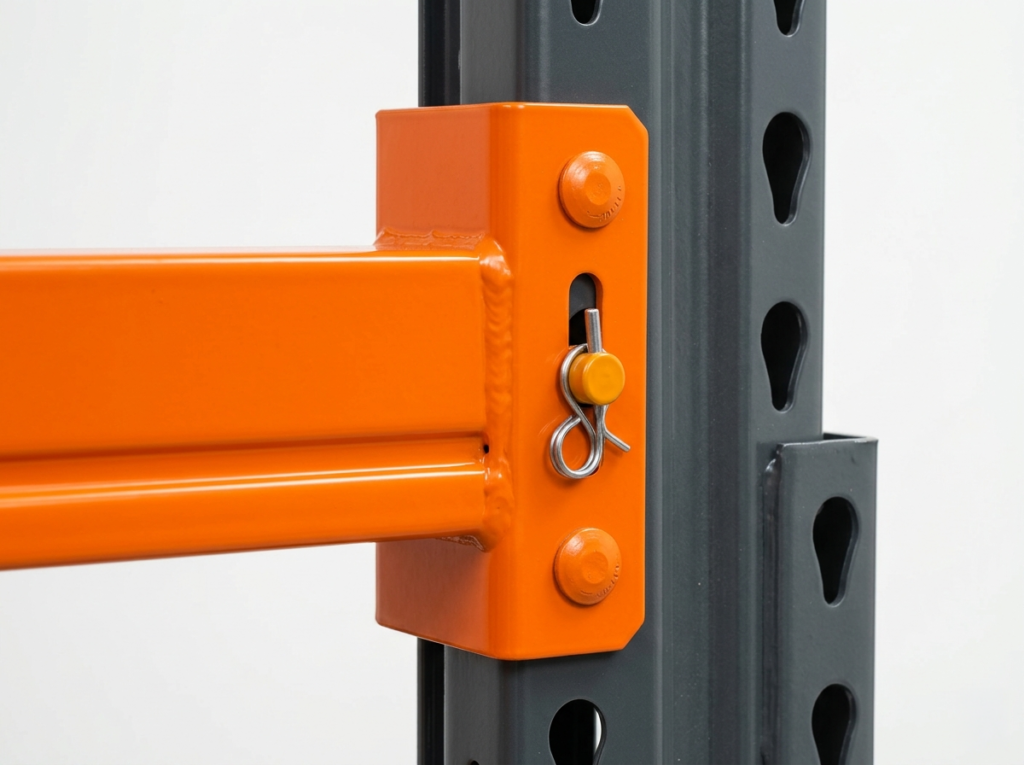
| Racking Specification Category | Industrial Standard Option | Heavy-Duty Premium Option | Best Choice for Application |
| Raw Steel Profile | Standard Mild Steel | Certified Q235B Carbon Steel | Heavy-duty pallet distribution networks |
| Surface Finish | Liquid Spray Paint | Electrostatic Powder Coating | Standard indoor industrial operations |
| Corrosion Protection | Basic Primer | Hot-Dip Galvanized Finish | Cold storage & high-humidity facilities |
| Impact Safety | Stripped Uprights | Integrated Base Steel Guards | High-traffic material handling zones |
4. How a Professional Factory Designs Your Racking Layout
From the Desk of a Senior LANTOO Project Engineer:
“In my 15 years of managing industrial racking projects, the biggest mistake buyers make is purchasing racks based on catalog dimensions without a proper layout check. I recently handled a project where a client ordered standard selective pallet racks, only to realize their forklifts didn’t have enough turning radius in the aisles.At LANTOO, we prevent this by requiring a warehouse blueprint before manufacturing. Our engineering team utilizes custom safety factors based on standard Q235B steel tolerances to ensure that every upright and beam can withstand real-world forklift impacts without structural fatigue.”
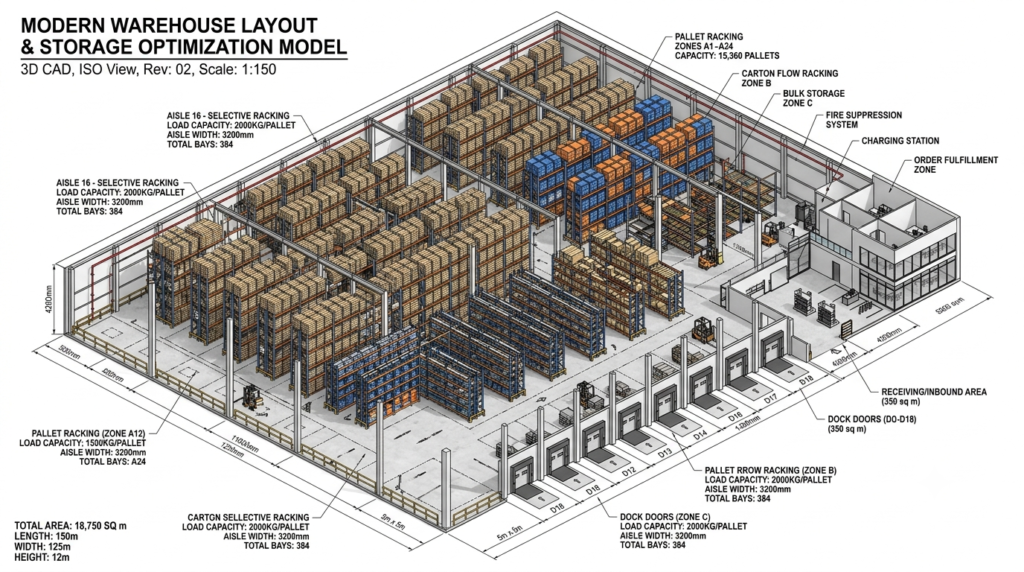
The Importance of Engineering Validation
Engineering a warehouse racking system requires comprehensive technological planning. Professional manufacturing facilities do not merely cut steel; they run structural simulations to ensure long-term stability. At LANTOO, we recently assisted a logistics provider in optimizing a 5,000-square-meter facility. By engineering a custom combination of heavy-duty pallet racks and drive-in systems, our team provided a free CAD warehouse layout design that increased their storage capacity by 35%. We ran FEA (Finite Element Analysis) simulations on the CAD model to guarantee a pallet rack load capacity of 2,000 kg per level, delivering the exact structural drawings alongside their quotation so their safety compliance team could approve the project instantly. You can read the full breakdown of this facility optimization in our warehouse layout design case study.
5. Common Pitfalls to Avoid in Industrial Storage Procurement
- 1. Focusing Solely on Lowest Price Per Bay: Cheap racking configurations almost always save money by using thinner steel gauges, reducing structural load limits, and shortcutting welding inspections.
- 2. Ignoring Local Seismic Code Requirements: If your facility is located in a seismically active zone, your racking requires heavy-duty base plates, specialized cross-bracing, and certified engineering anchor points to prevent collapse during an earthquake. Testing these structural limits must follow engineering design provisions outlined by the Racking Manufacturers Institute (RMI).
- 3. Omitting Forklift Protection Accessories: The lower 1 meter of a racking upright experiences constant exposure to forklift impacts. Skipping column protectors, rack end guards, and guide rails significantly reduces the life expectancy of your system.
- 4. Neglecting Manufacturer Brand Validation: Partnering with an obscure trading company means you lose engineering support, custom parts availability, and long-term warranties. Always procure directly from an established B2B manufacturer like LANTOO to ensure scalable system support.